
Strategies to help children’s in writing is an interesting topic right? Let’s join us to see the strategies!
Writing is an important part of our daily lives. However it is a difficult skill to learn and master. By getting a head start with some simple activities, we manage to help our children begin to develop her writing skills at an early age. This is how we contributing to their future success as a kindergarten children.
Strategies to help children’s in writing:
1) We provide a place for children.
It is significant for children possess a splendid place to write, such as a desk or table with a smooth, flat surface. Besides that, it also important to provide good lighting, especially in the classroom.
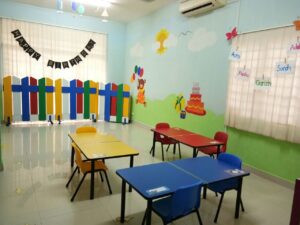


2) We provide the materials for children
Materials provided are like books, handout and stationery. Children love paper therefore we additionally provide plenty of paper (lined and unlined) and things to write with, including pencils, pens, and crayons. So they able to utilize the writing tools as they wish.
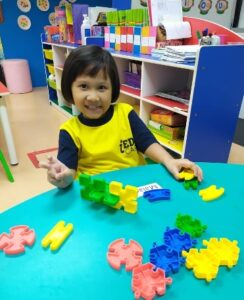
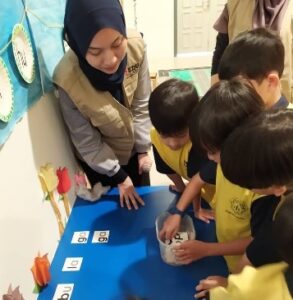
There are some learning disabilities which include writing difficulties.
-
Dyslexia is a common learning difficulty problem with reading, writing and spelling. Signs of Dyslexia include:
4) Problems remembering or naming letters, numbers and colors.
5) Difficulty learning nursery rhymes or playing rhyming games.
-
Dysgraphia
is a person who has problems with writing. The writing skills include handwriting and spelling. Hence, children with Dysgraphia may have only impaired handwriting, only impaired spelling without reading problems, or both impaired handwriting and impaired spelling.
-
Dysculculia
Dyscalculia is a learning disability in Mathematics. Children with Dyscalculia have trouble with Mathematics at many levels. They often struggle with key concepts like bigger vs. smaller. In addition, they can possess a hard time doing basic Mathematics problems.
-
Non-verbal learning disabilities
Nonverbal learning disorder is a learning disability with motor, visual-spatial and social skills. Children with Nonverbal learning disorder are often well-spoken and write with social cues.
-
Talking, but Not Connecting
Children with Nonverbal learning disorder frequently acquire great vocabularies. They quickly pick up words and phrases they read or hear from adults. However, their vocabularies can be deceiving. They struggle to engage during casual conversation especially when the topic doesn’t interest them. They might not notice whether another person finds a topic interesting, boring or uncomfortable. Moreover, they might not know when it’s time to allow someone else a chance to communicate.
-
Asking About Things, but Not Exploring
Children with Non Verbal Learning Disabilities love asking parents and teachers with questions. They may appeal for information about a new toy rather than playing with it to discover how it works. This may be because children with Non Verbal Disabilities repeatedly acquire limited visual-spatial skills. Instead of exploring the world around them firsthand, they prefer requesting information.
-
Strong Reading and Spelling, but Poor Comprehension
Children with Non Verbal Learning Disability are often competent readers. They are able to recognize words without sounding them out. They’re typically excellent at spelling and reading out loud. However, they often have trouble with reading comprehension and have difficulties the meaning of what they’ve read. They may struggle to recognize the moral of a story. Moreover, they may possess a hard time picking out important details or even in a simple passage.
Some strategies to take into account to help children’s in writing:
-
The components of handwriting
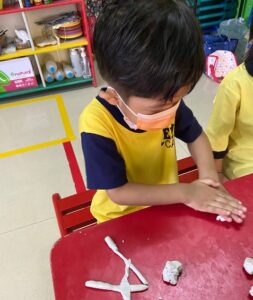
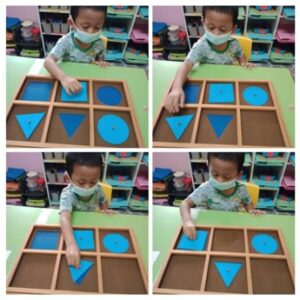
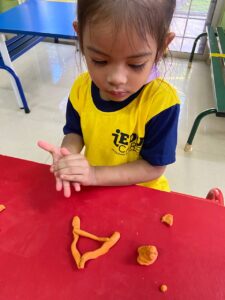
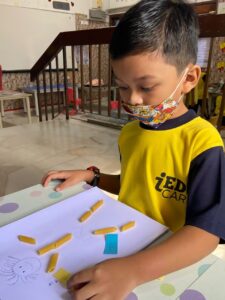
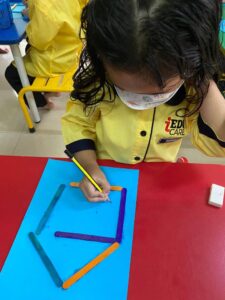
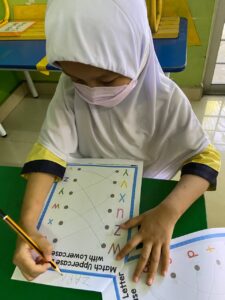
Firstly, a child must possess the fine motor skills to hold a pencil. That is the first skill that they must acquire it. Look at the diagrams; this is how we help them to develop their eyes-hand coordination to prepare them in writing. However, if a child is still reversing letters it may be a sign of a learning difficulty. Next, letter writing becomes more regular with practice, and they will also get more accelerated.

-
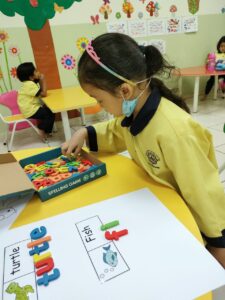
Help the child’s when they getting trouble started
Help children to think about the topic and generate some vocabulary before writing.

-
Decrease their anxiety and a lack of confidence
Our teachers instruct children that writing happens in stages. Decrease their anxiety by telling them the goal isn’t to produce an exquisite writing but encourage them to enjoy writing.
-
Decrease difficulty with self – expression
Some children have trouble producing the written language.
-
Trouble in organizing ideas
Some children have trouble establishing their ideas into a logical order. In this issue our teachers cut children’s sentences out, so they can re-arrange and re-write in the recent order.
-
Decrease messy handwriting
Our teachers encourage our children by assisting them to practice frequently in writing. We believe that, when children frequently write the handwriting will be better and tidy.

In conclusion, writing is a complex and cognitively demanding task. It requires a child to bring together both lower and higher order skills. Hence, it includes manipulating abstract ideas while paying constant attention to the spelling and punctuation conventions of written English.